Why SEO ROI Is Harder to Measure (But Still More Important Than Ever)
One of the most common frustrations businesses express about SEO is also one of the most understandable: “We’re not sure what we’re getting back from it.”
Unlike paid advertising, where budgets in and leads out can often be tracked in near real time, SEO operates in a much more complex environment. Organic search results are shaped by long-term authority building, evolving algorithms, and increasingly fragmented customer journeys.
And in today’s digital landscape—especially with the rise of AI-driven search—those challenges have only grown.
But here’s the truth that often gets overlooked:
SEO is not less valuable because it’s harder to measure. It’s harder to measure because it’s more deeply embedded in how customers actually make decisions.
The Expectation Gap: Why Businesses Get Frustrated With SEO
Many businesses come into SEO with expectations shaped by paid ads:
- Turn it on → get traffic
- Increase budget → increase leads
- Pause spend → results stop
So when SEO doesn’t behave the same way, frustration sets in.
The most common expectations we see include:
- Immediate ranking improvements
- Quick lead generation
- Clear attribution for every conversion
- A predictable month-to-month return
The reality is very different.
SEO is not a switch—it’s a system. And that system takes time to build momentum.
Why SEO Results Take Time (Even When Things Are Working)
SEO is built on compounding progress, not instant performance.
Before meaningful ROI appears, search engines typically need to recognize:
- Your site as a trustworthy source
- Your content as relevant and helpful
- Your business as an authority in a specific topic area
That recognition is earned through:
- Consistent content creation
- Technical optimization
- Backlink and authority building
- User engagement signals
- Long-term keyword relevance
This is why SEO often takes several months before results become obvious.
And even when results start appearing, they rarely show up in a straight line.
Instead, they build gradually—like momentum, not a spike.
The Bigger Challenge: SEO Attribution Has Become More Difficult
One of the biggest reasons SEO ROI feels harder to “prove” today is simple:
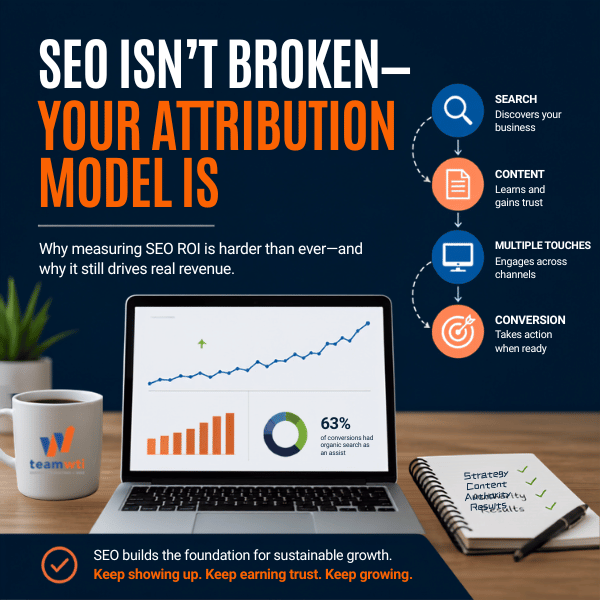
The customer journey is no longer linear.
A single conversion might involve:
- A Google search
- A blog post visit
- A return visit days later
- A branded search
- A Google Business Profile interaction
- A final click from an ad or direct visit
So the question becomes:
Which channel gets credit for the sale?
In most analytics platforms, the answer is oversimplified.
SEO often assists the conversion—but doesn’t always get credit for it.
This leads to a major blind spot where SEO appears less effective than it actually is.
AI Search and Google Updates Have Changed Visibility Metrics
Search is also changing in a way that complicates measurement even further.
With AI-generated search results and Google’s evolving SERP features:
- Users may get answers without clicking
- Brands may be seen without traffic being recorded
- Visibility may increase while sessions decrease
- Content may be cited indirectly in AI summaries
This creates a new reality where:
Impressions and visibility matter more than raw click volume alone.
A business may be influencing far more potential customers than analytics suggest.
Why SEO Still Matters More Than Ever
Despite these challenges, SEO remains one of the most important long-term marketing investments a business can make.
Here’s why:
1. Search Intent Is Still the Strongest Buying Signal
When someone searches:
- “foundation repair near me”
- “best commercial HVAC contractor”
- “helical pier installation training”
They are not browsing—they are actively looking for a solution.
SEO places your business directly in front of those high-intent moments.
2. AI Systems Depend on High-Quality Content
AI-driven search tools don’t create information from scratch—they synthesize existing content across the web.
That means:
- No content = no visibility
- Weak content = weak representation
- Strong content = stronger likelihood of being surfaced
SEO content is now feeding not just search engines, but AI discovery systems as well.
3. Organic Visibility Builds Long-Term Authority
Unlike paid ads, SEO compounds over time.
A strong SEO foundation can:
- Generate leads for years
- Support multiple service lines
- Strengthen brand trust
- Improve performance across all marketing channels
Even when ads stop, SEO continues working.
4. SEO Strengthens Every Other Marketing Channel
Good SEO doesn’t exist in isolation.
It improves:
- Paid advertising landing pages
- Website conversion rates
- Email marketing content
- Social media credibility
- Sales conversations
It becomes the foundation that everything else builds on.
Reframing What “Success” Looks Like in SEO
The biggest shift businesses need to make is not technical—it’s strategic.
Instead of asking:
“How many leads did SEO produce this month?”
A better question is:
“Is our organic visibility growing in a way that will produce sustainable leads over time?”
SEO ROI success should be measured through a combination of:
- Organic visibility growth
- Keyword expansion
- Branded search increases
- Engagement quality
- Lead assist contribution
- Long-term conversion trends
Not just last-click attribution.
Final Thought
SEO hasn’t become less valuable—it has become less visible in traditional reporting.
But behind the scenes, it continues to shape how customers discover, evaluate, and choose businesses.
The companies that understand this shift early are the ones that will continue to gain market share as search evolves.
Because in the end, SEO was never just about rankings. It’s about being present when your customer is ready to make a decision—and staying present throughout the entire journey, even when you’re not directly credited for it.
If you’re struggling to understand what SEO is really producing for your business, you’re not alone.
Modern search doesn’t always show its full impact in a single report or dashboard—but that doesn’t mean the impact isn’t there.
At Team WTI, we help businesses connect the dots between organic visibility, customer behavior, and real revenue growth.
If you want a clearer picture of how SEO is contributing to your marketing performance—and where it can go next—reach out to our team for a strategy conversation.