Understanding Generative Engine Optimization (GEO) in the Age of AI Search
If you’ve spent any time reading about digital marketing lately, you’ve probably seen a new acronym appearing alongside SEO:
GEO.
Short for Generative Engine Optimization, GEO is becoming one of the biggest conversations in digital marketing—not because SEO is disappearing, but because the way people search is changing.
Customers are no longer relying solely on Google. They’re asking ChatGPT, Gemini, Copilot, Claude, and Perplexity for recommendations, explanations, and purchasing advice before ever visiting a website.
So what exactly is GEO, and why should businesses care?
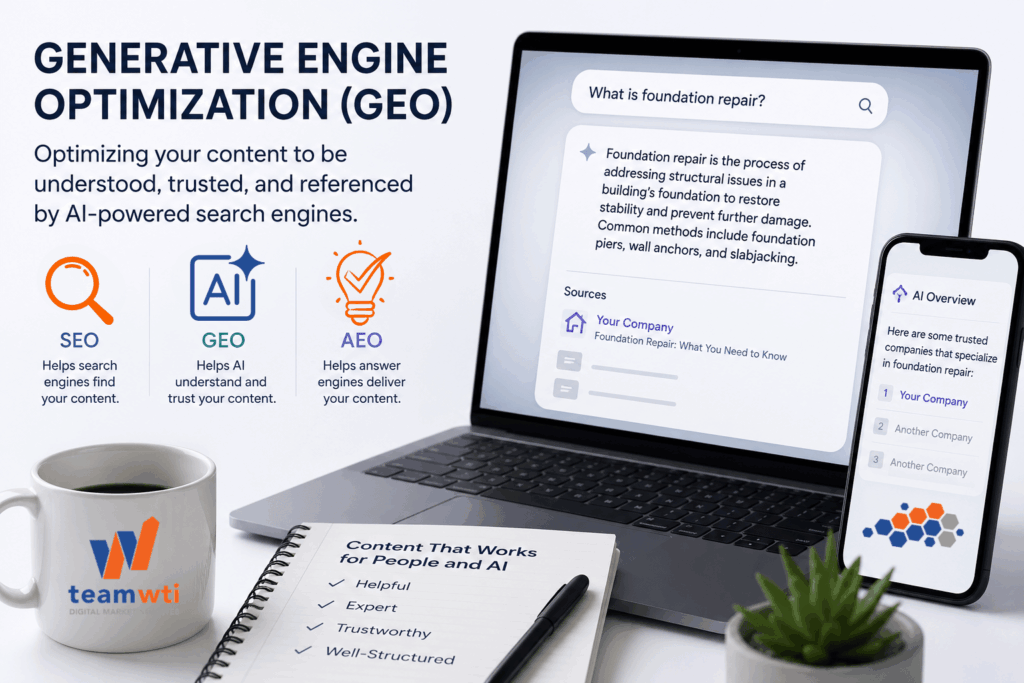
What Is Generative Engine Optimization (GEO)?
Generative Engine Optimization (GEO) is the practice of creating and organizing website content so artificial intelligence platforms can better understand, trust, and reference your business when generating answers.
Traditional SEO focuses on helping search engines discover and rank your website in search results.
GEO focuses on helping AI-powered search experiences understand your expertise well enough to include your business in the answers they generate.
Think of it this way:
- SEO helps people find your website.
- GEO helps AI understand your business.
The two work together—not against each other.
Why GEO Matters More Than Ever
Consumers are changing how they search.
Instead of searching for:
Foundation repair near me
They may ask:
Who is the best foundation repair company in my area?
Or:
How much does foundation repair usually cost?
Or even:
What questions should I ask before hiring a foundation repair contractor?
Rather than displaying ten blue links, AI tools often summarize information from multiple trusted sources into one conversational answer.
That means businesses are competing not only for rankings, but also to become one of the trusted sources AI uses when generating those responses.
GEO Starts With Great SEO
One of the biggest misconceptions surrounding GEO is that SEO no longer matters.
In reality, the opposite is true.
Strong SEO provides the foundation that allows GEO to work effectively.
Search engines and AI systems both rely on many of the same signals, including:
- Helpful, well-written content
- Clear page organization
- Accurate business information
- Fast-loading websites
- Internal linking
- Topical authority
- Consistently updated content
- Demonstrated expertise
Businesses that have invested in quality SEO are often already ahead when it comes to AI search.
The goal isn’t to abandon SEO.
The goal is to build upon it.
For a deeper look at how traditional SEO continues to drive long-term visibility, visit our SEO Digital Marketing Services page to learn how a strong SEO strategy supports both search engines and AI-powered search experiences.
Why EEAT Matters More Than Ever
One of the biggest misconceptions about AI search is that businesses need to create content specifically “for AI.”
In reality, AI systems are increasingly rewarding the same qualities that have always made content valuable for people.
Google refers to these qualities as EEAT:
- Experience
- Expertise
- Authoritativeness
- Trustworthiness
Whether someone discovers your business through Google Search, an AI Overview, or an AI assistant like ChatGPT, those qualities matter.
Businesses that demonstrate real-world experience, publish accurate information, answer customer questions honestly, and establish themselves as trusted experts are better positioned to earn visibility across both traditional search and AI-powered search.
Rather than viewing EEAT and GEO as separate strategies, we see them working together. Strong EEAT helps build the credibility that AI systems look for when deciding which sources to trust.
Want to learn more about how Google evaluates content quality? Read our complete guide to EEAT and why it continues to play an important role in modern SEO.
What AI Looks For in High-Quality Content
While companies like Google, OpenAI, Anthropic, and Microsoft don’t publish an exact formula for how AI chooses content, one trend has become increasingly clear: AI systems tend to favor content that demonstrates the same characteristics users value—clarity, expertise, accuracy, and trustworthiness.
AI systems tend to favor content that demonstrates:
Clear Answers
Pages should answer common questions directly rather than forcing readers to search for the information.
Real Expertise
Original insights, industry knowledge, and practical experience carry significantly more value than generic, rewritten content.
Logical Structure
Headings, subheadings, bullet lists, and organized sections help both readers and AI understand your content.
Fresh Information
Outdated content becomes less valuable over time. Regular updates signal that your information is current and relevant.
Trustworthiness
Businesses that consistently publish accurate, helpful information build authority with both people and AI systems.
What GEO Looks Like in Practice
Many businesses think GEO requires creating entirely new content.
Usually, it means creating better content.
Instead of a generic page titled:
Foundation Repair Services
A GEO-friendly approach might answer specific customer questions like:
- What causes foundation cracks?
- Can foundation problems get worse if ignored?
- What are the signs of foundation settlement?
- How long does foundation repair take?
- Is foundation repair covered by homeowners insurance?
These are exactly the kinds of questions people ask AI assistants every day.
The businesses that answer them clearly are more likely to become trusted sources.
Can You Optimize for ChatGPT?
This is one of the most common questions we hear.
The honest answer is:
Not directly.
You cannot submit your website to ChatGPT and request a higher ranking.
However, you can create content that is easier for AI systems to understand, trust, and reference.
That includes:
- Publishing helpful educational content
- Answering real customer questions
- Building topical authority within your industry
- Keeping information current
- Organizing content clearly
- Demonstrating genuine expertise rather than simply targeting keywords
The businesses that consistently educate their audience are positioning themselves for success across both traditional search engines and AI-powered search.
GEO, SEO, and AEO: How They Work Together
As search continues to evolve, you’ll hear several related terms:
SEO (Search Engine Optimization) focuses on improving visibility in traditional search engine results.
AEO (Answer Engine Optimization) focuses on creating content that directly answers user questions, making it easier for search engines and AI assistants to surface concise, accurate responses.
GEO (Generative Engine Optimization) focuses on helping AI systems understand and reference your business when generating comprehensive answers.
Rather than competing strategies, these disciplines complement one another.
At Team WTI, we see them as three parts of the same goal: helping your business become the trusted answer, no matter where customers search.
The Future of Search Is About Trust
Artificial intelligence is changing how people discover businesses, but one thing hasn’t changed.
People still want trustworthy information from knowledgeable experts.
Businesses that invest in educational content, answer customer questions honestly, and consistently demonstrate expertise will continue to build visibility—whether someone is searching Google, reading an AI Overview, or asking ChatGPT for guidance.
GEO isn’t about trying to game artificial intelligence.
It’s about making your expertise easier for both people and machines to understand.
The companies that embrace this shift today will be better positioned for the future of search tomorrow.
Frequently Asked Questions
GEO stands for Generative Engine Optimization, the practice of optimizing content so AI-powered search platforms can better understand and reference your business.
No. SEO remains essential. GEO builds upon strong SEO practices by helping content perform well in AI-generated search experiences.
SEO focuses on improving rankings in traditional search engines, while GEO focuses on increasing the likelihood that AI systems reference your content when generating answers.
AEO focuses on creating clear, direct answers to common questions, making content easier for search engines, voice assistants, and AI platforms to present to users.
Absolutely. Smaller businesses often have a competitive advantage because they can publish specialized, experience-based content that demonstrates real expertise within their industry.
Start by creating genuinely helpful content, answering your customers’ most common questions, keeping your website updated, strengthening your SEO foundation, and organizing your content clearly. Businesses that prioritize expertise and user experience are well positioned for both traditional and AI-powered search.
How Team WTI Is Helping Businesses Prepare for AI Search
At Team WTI, we don’t view Generative Engine Optimization (GEO) as a standalone service or the latest marketing buzzword. We see it as the natural evolution of creating exceptional digital experiences.
Our philosophy has always been simple: create content that genuinely helps people. As search evolves, that same philosophy is proving to be exactly what AI-powered search experiences value as well.
When we work with clients today, we’re not just thinking about where a page ranks in traditional search results. We’re also considering how well that content can be understood by AI systems that generate answers, summaries, and recommendations for users.
That means every optimization we make is designed to improve the experience for both human visitors and AI-powered search.
Our approach includes:
- Writing educational blogs that answer the questions customers are actually asking.
- Expanding content with helpful FAQs that provide direct, conversational answers.
- Building topical authority by creating comprehensive resources instead of isolated pages.
- Strengthening internal linking so both users and search engines can better understand relationships between topics.
- Improving headings, page structure, and readability to make information easier to navigate and interpret.
- Refreshing existing content with current information, real-world insights, and practical expertise.
- Optimizing images, alt text, and supporting media to provide additional context for accessibility, search engines, and AI systems.
- Demonstrating Experience, Expertise, Authoritativeness, and Trustworthiness (EEAT) throughout every piece of content we publish.
These aren’t “AI tricks,” nor are they shortcuts designed to manipulate search results. They’re best practices that create more useful, trustworthy, and comprehensive content for everyone.
As AI continues to reshape how people search for information, Team WTI will continue evolving alongside it. Our goal remains the same as it has always been: helping businesses become trusted authorities in their industries by creating content that educates, builds confidence, and earns visibility—whether someone finds it through Google Search, an AI Overview, ChatGPT, Gemini, or whatever comes next.
Because while search technology will continue to evolve, one principle remains constant: businesses that consistently provide the most helpful, accurate, and trustworthy information are the ones most likely to be discovered.
Ready to Prepare Your Website for AI Search?
Search is evolving, and businesses that adapt early will be in a stronger position as AI continues to change how customers discover products, services, and local businesses.
Whether you’re wondering how AI Overviews may affect your website traffic, curious about Generative Engine Optimization (GEO), or looking for ways to strengthen your SEO strategy for both traditional and AI-powered search, Team WTI is here to help.
Our team works with businesses across a wide range of industries to create websites and content strategies that are built for today’s search landscape—and ready for tomorrow’s.
Ready to see how your website stacks up?
Schedule an AI Search & SEO Strategy Call with Team WTI. We’ll review your current online presence, discuss how AI is impacting search in your industry, and identify practical opportunities to improve your visibility for both search engines and AI-powered search experiences.
We look forward to helping your business become the trusted source your customers—and the next generation of search—can confidently find.